
Introducing Unitools: The Universal Interface for AI Actions
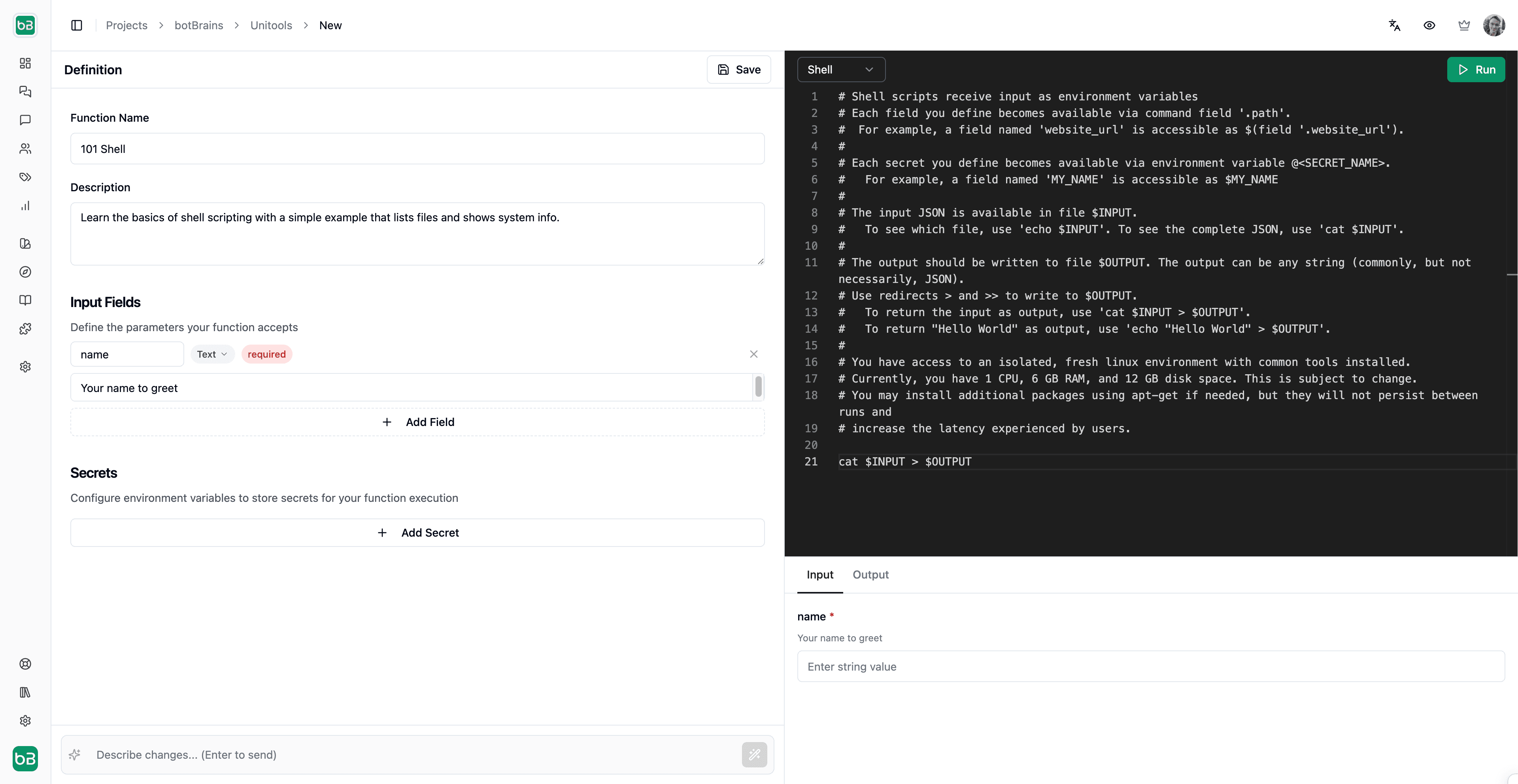
Unitools connect your AI to ERPs, CRMs, shop systems, and in-house software. Instead of expensive one-off integrations, small code units provide safe read and write actions.

Liam van der Viven
Co-Founder & CTO at botBrains
AI in customer service needs more than knowledge from an FAQ. It needs to look up a customer's orders and, when appropriate, change a shipping address, upgrade a subscription, or hand a case over to another team. Connecting a help center is not enough. To be useful in real operations, an AI needs read and write access to shop systems, ERPs, CRMs, and other operational software.
That is exactly what Unitools are for. With Unitools, botBrains introduces a new action layer for AI agents in customer service. They give your AI read and write actions for almost any target system, whether that is an ERP, CRM, shop system, internal database, or proprietary in-house software. If your support team can look up orders, change addresses, upgrade subscriptions, or trigger workflows in a system today, botBrains can now do that too.
Why we launched Unitools
System integrations used to be one of the most expensive and slowest parts of rolling out AI in support, making them a real inhibitor to broader automation. A typical example from the past was:
970.00 EUR per developer day x 3 days x 2 systems = 5,820.00 EUR
That number did not come from some abstract platform tax. It came from the fact that nearly every customer runs a different system landscape. In addition to common platforms like SAP or Microsoft Dynamics, we continually see unfamiliar ERP systems such as Fashion XL ERP, Zeyos, Adagio ERP, Veeva Vault, or custom-built internal software. There are simply too many systems to build every integration once and amortize it across many customers, so individual customers often had to pay for the work themselves. That made projects expensive, and expensive made them slow.
What Unitools make possible
Unitools let botBrains talk to more than just conventional APIs. They can connect to databases, internal tools, and custom backends just as easily as to REST or GraphQL endpoints. That includes querying SQL, Redis, or MongoDB, pulling data from business systems in real time, and writing changes back safely. The result is not a chatbot that merely answers questions, but an agent that can perform operational tasks such as looking up orders in an ERP, checking inventory, reading contract or subscription data from a database, triggering a refund via API, or executing a workflow in an internal tool.
Just as important are the smaller but high-value actions that support teams perform every day. An agent can trigger an SMS verification through an API before exposing sensitive account details or delivery information. It can open a Zendesk side conversation automatically through the Zendesk AI agent workflow when a case needs input from logistics, finance, or a specialist team. It can create meetings, apply address changes, or combine status information from multiple systems into a single response. Unitools are therefore not just an integration feature. They are the foundation that lets AI take meaningful action inside real support processes.
Why a simple API builder is not enough
At first glance, these integrations sound straightforward: connect an API, read some fields, return a result. In production, the work always sits in the details. Many systems do not store expressive values like ORDER_SUBMITTED, ORDER_PICKED, or ORDER_IN_TRANSPORT, but only internal codes such as 1, 2, or 3. Those values are barely readable for humans without context, and the same is true for AI. Between a raw system response and a useful action, there is almost always logic for validation, transformation, authentication, error handling, and safeguards around write operations.
That is why code remains the only universal interface. Not because writing code is an end in itself, but because real business logic cannot be compressed into a rigid HTTP builder. Sometimes a few lines are all it takes to model system behavior explicitly, validate inputs, or encapsulate a safe write process. Unitools embrace exactly that approach. Each action contains the logic required for a specific workflow instead of pretending every system can be modeled as the same generic request. That means the AI's understanding is not left to inference alone, but deliberately described in code.
A broader look at the new capabilities
The practical difference becomes clear when you look at the breadth of workflows now possible. In the past, an integration often meant a single lookup, such as fetching an order status. With Unitools, the AI can combine data from multiple sources, validate customer input, apply internal business rules, and then write changes back to the right systems. That turns isolated API calls into complete actions.
A good example is an order support case. The agent can fetch order data from an ERP, apply the exact business understanding for internal status values and edge cases as defined for that system, require SMS verification before an address change, update the shipping address in the shop system, and open a Zendesk side conversation for the warehouse when manual intervention is needed. From the customer perspective, that feels like one smooth support interaction. Under the hood, botBrains is coordinating databases, APIs, and internal tools while executing a modeled workflow instead of freely inferring what individual system values might mean.
Early success
The biggest effect of Unitools is speed. New connections used to mean several developer days per system. Today, many customers can create these actions themselves, or set them up together with us in a 30-minute call. That reduces integration cost, but more importantly it shortens the time from idea to production. Instead of planning large custom projects, teams can start with concrete support actions, launch quickly, and expand from there. A good example of how much direct ERP access can improve automation is our case study on how Ballsportdirekt reduced tickets by 90 percent.
Try Unitools now
Unitools are the reason botBrains can now move quickly even in unusual ERP, CRM, and in-house environments. They turn knowledge, APIs, and databases into real actions that an AI agent can execute safely. If you want to understand how these actions fit into larger support operations, it is also worth reading about the AI Support Flywheel and why strong escalations are essential to customer acceptance. If you want to give your AI read and write capabilities across your systems, you can start using Unitools now.